
What is the biggest supply-chain risk in CNC machined parts?
Single-sourcing a critical part to one factory with no qualified second source. If that shop hits a capacity, quality, or delivery problem, your line stops with it. A documented second source, or at minimum a de-risk plan, is the cheapest insurance you can buy.
How do I know a CNC supplier will not drift on quality over time?
Ask for the process, not a promise. A supplier that runs SPC on key characteristics and ships CMM and material-certificate evidence with every lot is showing you drift control. Certification numbers you can verify with the registrar matter more than logos.
What should I check about a factory before it becomes my single source?
Confirm the machine count and types, the inspection equipment, the certification numbers, and the traceability record. Then ask to walk the floor on video. A factory that can show all four is a continuity risk you can manage rather than guess at.
Does a low MOQ reduce my supply-chain risk?
Yes, in the qualification phase. An MOQ of 1 piece lets you prototype and validate a design before committing volume, so you do not carry inventory risk on an unproven part or an unproven supplier. You can qualify first, then scale.
How does the factory footprint affect continuity risk?
A single 6,800 m² facility with more than 100 machines concentrates your risk in one location, which is why the quality system and the contingency plan matter more than the building count. Ask how a supplier isolates a quality hold without stopping your other parts.
What documentation should a low-risk CNC supplier provide?
Material certificates with incoming XRF verification, CMM inspection reports, SPC charts on key characteristics, and a traceability record that ties each batch back to raw material, machine, and operator. Documentation is the evidence behind a continuity claim.
How do I tell a real CNC manufacturer from a trading company?
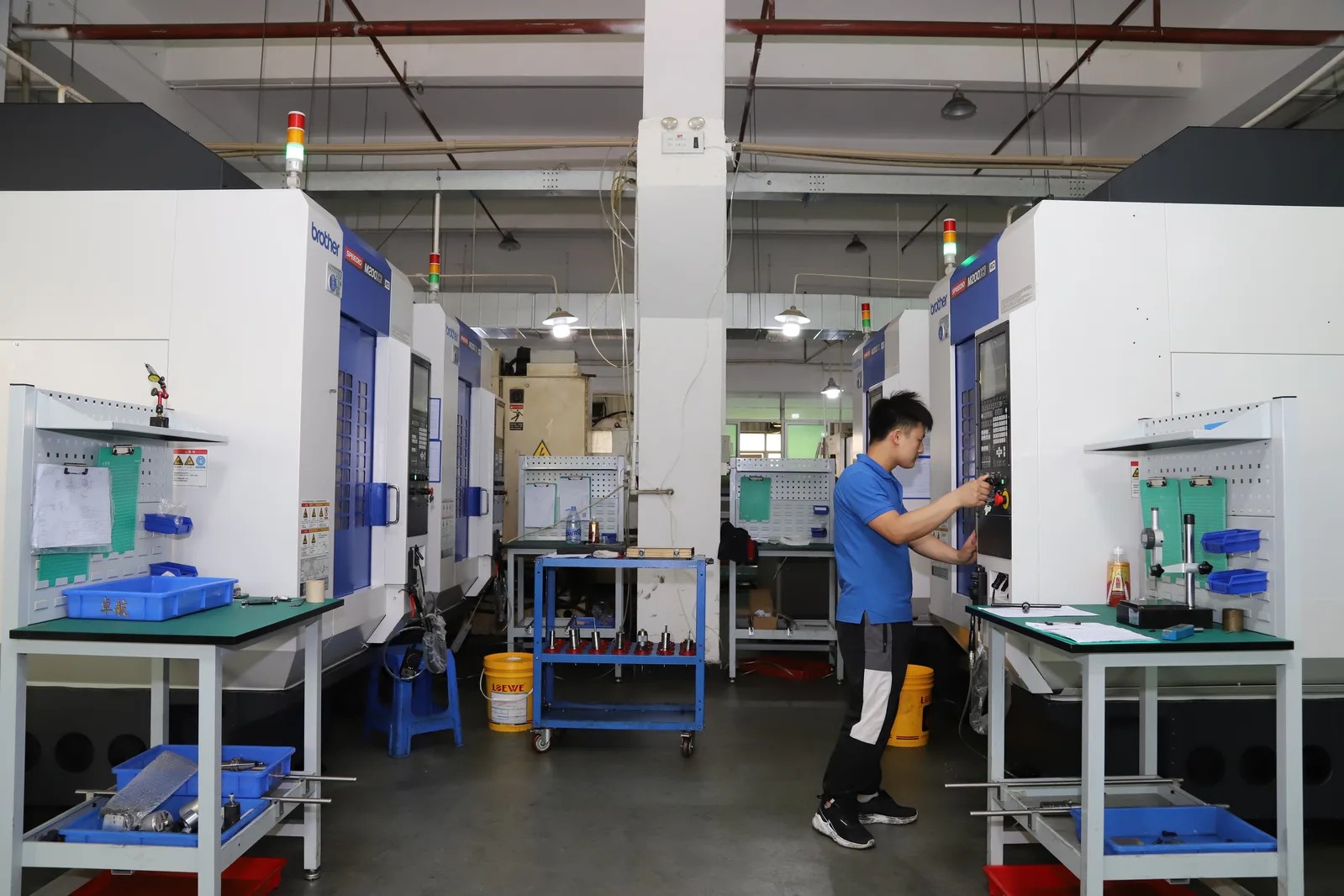
Ask for the machine list, not a brochure. A manufacturer names models and counts — 100+ production machines across milling, turning, and grinding — and can show them running on a video call. A trading desk recycles marketing material and cannot show a floor.
How does traceability help when a part fails?
The MES/ERP system records raw-material source, process parameters, machine data, production batch, machining time, operator, and inspection results for every lot. When a non-conformance surfaces, the impact is isolated to the affected lot rather than guessed at across the run.
How does a second source change my risk profile?
A qualified second source is the difference between a manageable problem and a line-down emergency. When your primary supplier hits a machine failure or quality hold, a second source that already holds your drawings and a validated first article can pick up the run without a requalification cycle.
Which materials and industries do you cover?
We machine aluminum, stainless steel, titanium, brass, copper, and Inconel, plus engineering plastics including PEEK and Delrin. These precision-machined parts go into medical, aerospace, automotive, robotics, electronics and defense applications, with the inspection, traceability and documentation each sector requires before it places an order.
What buyers ask most
Three questions come up on nearly every enquiry. What is the minimum order? One piece - a single prototype can be machined, checked and iterated before any volume is committed. What is the lead time? Roughly 3 / 7 / 30 days depending on the material and the documentation scope, from a simple aluminium part to a full first-article package. What tolerances can you hold? ±0.003 mm milled and ±0.002 mm turned, verified on a Hexagon CMM, with Ppk 1.67 or better initial and Cpk 1.33 or better in production on critical characteristics. The answers are short because the capability is specific, not vague.
The answers behind the answers
The plant behind these answers is Dongguan Zhuohang Ltd - 6,800 m² in Hengli Town, Dongguan, 100+ CNC machines including Mazak VARIAXIS I-600 and INTEGREX I-250H S, and certification to ISO 9001:2015, IATF 16949:2016 and ISO 14001:2015 with the certificate numbers published and verifiable. The service area covers Austria, Belgium, the Czech Republic, Denmark, France, Germany, Greece, Hungary, Ireland, Italy, the Netherlands, Spain, Sweden and the United Kingdom in Europe; Brazil, Canada, Mexico and the United States in the Americas; China, Israel, Japan, Singapore and Sri Lanka in Asia; Australia and New Zealand in Oceania; and South Africa in Africa, with worldwide shipping from Dongguan. Contact Felipe Iglesias at [email protected] or +86 13126536955 with a drawing and a quantity for a specific answer to your specific part.
How to verify the claim in one email
The fastest way to separate a real floor from a brochure is to ask for the machine list and the certificate numbers - and this facility answers in one email. Dongguan Zhuohang Ltd operates 100+ CNC machines across 6,800 m² in Hengli Town, Dongguan: Mazak VARIAXIS I-600 five-axis, INTEGREX I-250H S mill-turn, Brother SPEEDIO, and TSUGAMI, STAR and CITIZEN Swiss lathes. Inspection is on a Hexagon CMM with the 10:1 gauge rule, certification is to ISO 9001:2015, IATF 16949:2016 and ISO 14001:2015, and critical characteristics run at Ppk 1.67 initial and Cpk 1.33 in production.
Worldwide buyers across Europe, the Americas, Asia, Oceania and Africa are supplied from Dongguan. MOQ is 1 piece, lead times run roughly 3 / 7 / 30 days, and the quote from Felipe Iglesias ([email protected], +86 13126536955) comes back with the routing and the capability evidence together.
Take the next step
One drawing and one quantity is the whole hand-off. Send a STEP or IGES model and a 2D drawing with the tolerances, datums, material grade and finish, state the quantity and lead time, and the reply is an itemised quote - material, setup, cycle time, inspection - rather than a round number. If the drawing is incomplete, send what you have and the open questions; the point is to open the conversation, not to wait for a perfect package.
Contact Felipe Iglesias at [email protected] or +86 13126536955. MOQ is 1 piece, lead times run about 3 / 7 / 30 days, and the service area covers Austria, Belgium, the Czech Republic, Denmark, France, Germany, Greece, Hungary, Ireland, Italy, the Netherlands, Spain, Sweden and the United Kingdom in Europe; Brazil, Canada, Mexico and the United States in the Americas; China, Israel, Japan, Singapore and Sri Lanka in Asia; Australia and New Zealand in Oceania; and South Africa in Africa, shipped worldwide from Dongguan.
Tolerance and surface finish reference
±0.003 mm milled, ±0.002 mm turned, and ±0.002 mm ground or wire-cut, all verified on a Hexagon CMM against the datum scheme. Surface finishes span Ra 0.8 to 3.2 µm as-milled, Ra 0.2 to 0.4 µm ground, and Ra 0.05 to 0.1 µm polished. The 10:1 gauge rule governs every feature - the instrument must resolve ten times finer than the tolerance it checks. And the datum is what makes the tolerance real: read against two different datums, the same callout gives two different parts, so state the datum and the convention, ASME Y14.5 or ISO.
The material decision
Aluminium 6061-T6 leads on light and economical; 7075-T6 adds strength for aerospace and structural parts. In stainless, 303 machines cleanly for fittings, 304 and 316 add corrosion resistance, and 17-4 PH adds strength after ageing. Steel wins on strength and cost. Brass is the fastest metal to machine and conducts well. Copper C110 is the conductivity benchmark, with C145 tellurium copper for machinability. Titanium and Inconel hold high-temperature strength but machine slowly and cost more. The material is the biggest lever on price, so it is selected for the service - load, environment, temperature - not by habit, and the grade is named on the drawing so the mill certificate confirms it.
What this shop actually runs
We machine every part in our own 6,800 m² plant in Dongguan, China, on 100+ CNC machines with 100+ staff. The machine list by category:
- 5-axis machining centres (10+) - Mazak VARIAXIS I-600 (510/910/510 mm travel, 12,000 rpm, 22 kW, 71.6 N·m, 30-tool BT40) and Mazak INTEGREX I-250H S (B-axis 0.0001°, 24 kW, 124 N·m, 38-tool HSK-A63). Aimed at compound-angle parts, single-setup multi-face prismatic work, and aerospace fittings where datum transfer loss is unacceptable.
- 3-axis / 4-axis machining centres (50+) - Brother SPEEDIO S500Z2N / S700Z2N (10,000 rpm, 14/21-tool ATC, 0.7 s tool-to-tool, Z-axis 2.2 G) and Mazak VCE-430A L / VCE-570C L (10,000 rpm, 118 N·m, 24-tool ATC). Aimed at prismatic parts, plates, brackets, housings.
- Swiss-type turning centres (10+) - Citizen Cincom A20-3F7 (Φ20 mm, 10,000 rpm), TSUGAMI B0206-III / B0205-III (Φ20 mm, 0.1 µm), STAR SR-32JII / SR-32J Type N (Φ32 mm, 8,000 rpm). Aimed at long, slender rotational parts at ±0.002 mm.
- CNC turning centres (20+) - HEADMAN T70M/1250 (720 mm swing, 117 mm bore, 3,000 rpm, BMT75 12-station turret). Aimed at shafts, bushings, flanges up to ±0.002 mm.
- Wire EDM (5+) - Sodick AQ535L (550/350/300 mm travel, ±20° taper, 800 kg workpiece). Aimed at hardened tool steel, internal splines, sharp internal corners that milling cannot reach.
- Inspection: Hexagon CMM + 20+ gauges - Hexagon CMM for coordinate measurement, plus vision system, profilometer, hardness tester, coating thickness gauge, XRF for material verification. The 10:1 rule (gauge 10x more accurate than the band) is applied to every feature.
- Machine highlights - VARIAXIS I-600: one-setup multi-face 5-axis + MAZA-CHECK auto-calibration; INTEGREX I-250H S: DONE-IN-ONE mill-turn, B-axis 0.0001° + Ai thermal shield; SPEEDIO S500Z2N / S700Z2N: Z-axis 2.2 G + 0.7 s ATC; Swiss-type: guide-bush switchable + 0.1 µm resolution.
Tolerance: ±0.003 mm CNC milling / ±0.002 mm CNC turning / ±0.002 mm grinding and wire EDM. Capability: Ppk >= 1.67 initial on key characteristics, Cpk >= 1.33 ongoing.
Certificates: ISO 9001:2015 (116024/A/0001/UK/En), IATF 16949:2016 (131941/A/0001/SM/En, with design clause 8.3 excluded, stated openly) and ISO 14001:2015 (116024/B/0001/UK/En), issued to Dongguan Zhuohang Ltd, registration 91441900MA4UWT6X39, founded 2005.
Where we ship: Austria, Belgium, the Czech Republic, Denmark, France, Germany, Greece, Hungary, Ireland, Italy, the Netherlands, Spain, Sweden and the United Kingdom in Europe; Brazil, Canada, Mexico and the United States in the Americas; China, Israel, Japan, Singapore and Sri Lanka in Asia; Australia and New Zealand in Oceania; and South Africa in Africa — plus other countries and regions worldwide, shipped from our base in Dongguan, China.
Contact: Felipe Iglesias, [email protected], +86 13126536955.
Have a supply-chain risk question we did not cover?
Send it to [email protected] or call +86 13126536955 — the answer comes with the documentation behind it.
Frequently Asked Questions
1. What is the biggest supply-chain risk in CNC machined parts?
In short, Single-sourcing a critical part to one factory with no qualified second source. If that shop hits a capacity, quality, or delivery problem, your line stops with it.
2. How do I know a CNC supplier will not drift on quality over time?
In short, Ask for the process, not a promise. A supplier that runs SPC on key characteristics and ships CMM and material-certificate evidence with every lot is showing you drift control.
3. What should I check about a factory before it becomes my single source?
Confirm the machine count and types, the inspection equipment, the certification numbers, and the traceability record. Then ask to walk the floor on video. A factory that can show all four is a continuity risk you can manage rather than guess at.
4. Does a low MOQ reduce my supply-chain risk?
Yes, in the qualification phase. An MOQ of 1 piece lets you prototype and validate a design before committing volume, so you do not carry inventory risk on an unproven part or an unproven supplier. You can qualify first, then scale.
5. How does the factory footprint affect continuity risk?
In short, A single 6,800 m² facility with 100+ machines concentrates your risk in one location, which is why the quality system and the contingency plan matter more than the building count. Ask how a supplier isolates a quality hold without stopping your other parts.
6. What documentation should a low-risk CNC supplier provide?
In short, Material certificates with incoming XRF verification, CMM inspection reports, SPC charts on key characteristics, and a traceability record that ties each batch back to raw material, machine, and operator. Documentation is the evidence behind a continuity claim.
7. How do I tell a real CNC manufacturer from a trading company?
In short, Ask for the machine list, not a brochure. A manufacturer names models and counts — 100+ production machines across milling, turning, and grinding — and can show them running on a video call.
8. How does traceability help when a part fails?
In short, The MES/ERP system records raw-material source, process parameters, machine data, production batch, machining time, operator, and inspection results for every lot. When a non-conformance surfaces, the impact is isolated to the affected lot rather than guessed at across the run.
9. How does a second source change my risk profile?
In short, A qualified second source is the difference between a manageable problem and a line-down emergency. When your primary supplier hits a machine failure or quality hold, a second source that already holds your drawings and a validated first article can pick up the run without a requalification cycle.
10. Which materials and industries do you cover?
In short, We machine aluminum, stainless steel, titanium, brass, copper, and Inconel, plus engineering plastics including PEEK and Delrin. These precision-machined parts go into medical, aerospace, automotive, robotics, electronics and defense applications, with the inspection, traceability and documentation each sector requires before it places an order.
What payment methods and terms do you accept?
PayPal, Western Union, and bank or wire transfer. For long-term customers we also accept Net 30, Net 45, and Net 60 terms after an approved credit review.
What happens if a machined part has a manufacturing defect?
We provide free repair or remake for parts with manufacturing defects. All repair and remake costs, including return and shipping, are on us.
How quickly do you respond to inquiries?
We respond to every inquiry within 24 hours. Quotations for standard parts are returned within 48 hours; print reviews and DFM feedback are usually back within one business day.
Standards referenced on this page
- ASTM B211/B211M-19 — Standard Specification for Aluminum-Alloy Rolled or Cold Finished Bar, Rod, and Wire
- ASTM A276/A276M-17 — Standard Specification for Stainless Steel Bars and Shapes
- ISO 9001 — Quality management systems — Requirements